Selection Guide
SEE THE PRODUCT SUMMARY TABLE AT THE BOTTOM OF THIS PAGE.
Consider the following list of items when choosing a battery charger:
- What type of battery will be recharged?
- Flooded, Sealed, VRLA, AGM, GEL, etc.
- How large is the battery?
- This is the capacity in amp hours. Some batteries will not have this number displayed on their label. Typical labels will show either CCA (Cold Cranking Amps) or Reserve Capacity in Minutes. Reserve capacity is the number of minutes that the battery can deliver a constant 25 amps to a load.
- How is the battery being used?
- What is the application? SLI, Deep Cycle, or Standby Power.
- How deeply will the battery be discharged?
- Shallow cycling (discharging 20% to 50% of the battery’s capacity) does not usually require as much recharge power as deep cycling (discharging more than 50% of the battery’s capacity).
- How often will the battery be discharged?
- In general, the more often the battery is discharged, the higher the power you want to use to recharge it. This is particularly important if the battery is deeply discharged. A good rule of thumb for deep cycle batteries is to only discharge them once every 24 hours, otherwise there may not be sufficient time for the batteries to recover between discharges. This has been a serious point of concern for many industrial applications. It has also been a great disappointment to many consumers who have expected to be able to repeatedly discharge large deep cycle batteries and then recharge them with low power chargers.
- How much time is available to recharge the battery before it has to be discharged again?
- This question is where many industrial systems designers get into trouble. Industrial battery use is usually the most demanding, particularly with electric vehicles that require a mixture of high and moderate rate deep discharges. Time must be allotted not only to recharge the battery, but also to let it rest in a fully charged state between deep, high rate discharges. If you need to replace 100 amp hours in 4 hours, then you need at least 25 amps. However, the truth is that you will need 30 to 40 amps or more and probably 6 to 8 hours because of the way that chargers and batteries behave after the battery is 80% recharged. It is more difficult, and it takes a lot longer to replenish the last 20% of the battery charge than it does to replenish the first 80% of the battery charge. Even if you can get the battery completely recharged in 6 to 8 hours from a deep discharge, it is still not wise to deeply discharge a lead acid battery more than once a day.
- Selecting a Charger:
- Once you have fully considered the battery type, size, and how it is to be used, then you can make a more informed decision about the charger that you need. Deltran’s full line of automatic, microprocessor controlled charger products includes both linear regulators and switch-mode power converters, in power ranges from 4.5 watts (6 volts at 0.75 amps) to 600 watts (24 volts at 20 amps, 36 volts at 15 amps, and 48 volts at 10 amps).
- Something to Consider Before Selecting or Purchasing a Battery Charger:
- A wide variety of choices are available. Just remember that when you evaluate the cost of a Deltran charger, it’s not just the charger that you are paying for. It’s the reputation of the company, the service before and after the sale, and the guarantee that if you are not satisfied for any reason, we’ll make it right. Most important of all is the fact that you are making an investment in your future leisure time by purchasing the convenience of not having to replace your batteries as often as before, no matter what the application. Neither chargers nor batteries are inexpensive. Our experience over the last decade with both individual consumers and large corporate customers has shown us that batteries can last much longer with a good charger. It is not uncommon for individual consumers to double or in some cases even triple their batteries useful life with Deltran chargers. Industrial users occasionally double their battery life, and typically get at least an additional 50% service from their batteries.
Deltran
Charger Product Summary |
||||||
Most Popular Models Highlighted |
||||||
| Charger Models | Output Voltage | Output Current | Output Power Total | Charging Software* / Battery Type | AC Voltage / Frequency Input | |
| (Volts) | (Amps) | (Watts) | ||||
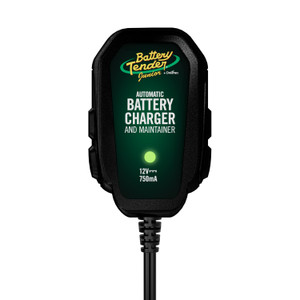
| Battery Tender Jr. | 6V | 0.750A | 4.5W | 3 Step STD & AGM | 120 VAC 60 Hz | |
| 12V | 0.750A | 9W | ||||
| Waterproof 800 | 12V | 0.800A | 10W | 3 Step STD & AGM | 100 to 240 VAC 50/60 Hz (Automatic, Universal Input) |
|
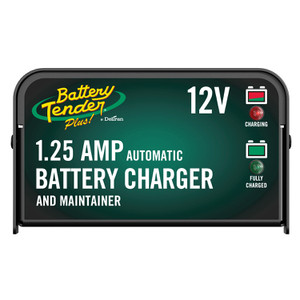
| Battery Tender Plus | 6V | 1.25A | 9W | 4 Sep STD & AGM or GEL | 120 VAC 60 Hz | |
| 12V | 1.25A | 18W | ||||
| International Battery Tender |
12V | 1.25A | 18W | 4 Step STD & AGM | 100 to 240 VAC 50/60 Hz (Automatic, Universal Input) |
|
| International BT 4-Bank |
12V | 1.25A | 72W | 4 Step STD & AGM | 100 to 240 VAC 50/60 Hz (Automatic, Universal Input) |
|
| Multiple Output Shop Chargers: 5 & 10 Bank |
12V | 2.0A | 144W / 288W | 4 Step STD & AGM | 120 VAC 60 Hz | |
| Portable Power Tender | 12V | 5.0A / 2.5A | 70W / 35W | 4 Step STD & AGM | 100 to 240 VAC 50/60 Hz (Automatic, Universal Input) |
|
| Power Tender Plus, Vibration Resistant, Waterproof (VRW) | 12V | 5A | 70W | 4 Sep STD & AGM | 120 VAC 50/60 Hz | |
| 24V | 2.5A | 70W | ||||
| High Frequency SuperSmart Chargers, Golf Cart Style & Industrial with Deltran Adaptive Charging (DAC) and Emergency Vehicle Chargers. | 12V | 20A | 300W | 4 Step GEL, or 5 Step STD & AGM |
120 or 240 VAC 50/60 Hz (Factory Selectable) |
|
| 24V | 20A | 600W | ||||
| 36V | 15A | 600W | ||||
| 48V | 10A | 600W | ||||
| High Power, Heavy Duty Portable, DV Chargers |
DVS-20 Single Output | 12V | 20A | 300W | 4 Step GEL, or 5 Step STD & AGM |
120 VAC 60 Hz |
| DVD-40 Dual Output |
12V | 20A | 600W | |||
*Note: All Deltran battery chargers will charge all types of lead acid batteries: either flooded (standard STD), sealed maintenance free Absorbed Glass Mat (AGM), or sealed maintenance free gelled electrolyte (GEL) batteries. However, for optimum battery performance in deep cycle applications (for example, running a trolling motor), it is best to chose the Deltran charger that has the charging software specifically designed for the battery type. Fortunately, since the technical staff at Deltran has developed charging software that works equally well for both STD & AGM batteries, the only choice to be made is between 2 models: either STD & AGM or GEL software.
Friend us on Facebook
Follow us on Twitter
Read our Blog